As a gay man fascinated by science fiction, I’ve read many books over my 60 years. Science fiction was my escape from the struggle of being gay in a small, rural town. I read many authors, including Arthur C. Clarke, Isaac Asimov, Ray Bradbury, H. G. Wells, Jules Verne, and many more. In their books, I found amazing adventures about traveling to the stars, living on strange planets, and humanity’s evolution.
Looking back, that was no small feat for a boy who read The Lord of the Rings at 10. As I hit puberty, I grew fearful of the real world and of being bullied in school, so books became even more important. It wasn’t until I left home at 17 that I realized something missing from the science fiction books I was reading: gay men. All the heroes were virtually white, straight men.
I can remember a day in the 1980s when I was waiting for a bus to see my parents and had plenty of time before I had to be at the Greyhound station. So I went book and music shopping on Yonge Street in Toronto. I found myself in a very large bookstore. I can’t remember its name, but I remember the rows upon rows of books.
I went straight to the science fiction section and started looking through titles. I usually look at the title first, then the cover, and finally the back cover. If it doesn’t grab me, I move on to the next. I found a few interesting ones before I picked up one book. I had always been on the lookout for a book with a gay character. It wasn’t really an active search, more of a passive, hopeful one.
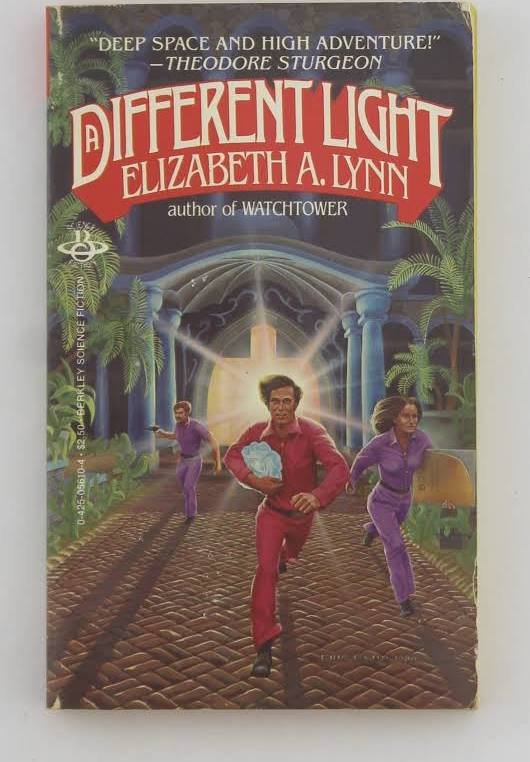
I came across a novel with the cover reading A Different Light by Elizabeth A. Lynn. I had no idea who she was. The cover showed a man running with a mask in his arms, a woman with big hair running beside him with a tablet, and a man behind him with a moustache, also running. The last man held some sort of weapon at the ready. It must have triggered something in my mind, and my hopes leaped as I turned the book over.
It was about a man who was ill with what turned out to be cancer, even though it had been eradicated. He was told he would live 20 more years if he didn’t travel outside of space-normal. But he was willing to risk it all to make the jump into the Hype, the shimmering “not space,” for one year among the stars. So I turned to the first chapter, and to my surprise, the first page showed Jimson looking at an image cube of a man named Russell. The man in the image wore emerald earrings and had red hair. Jimson reacted to the image, and I knew this book had gay characters!
On the bus home, I discovered pirates, lovers, psychics, and distant planets. I was in rapture! I remember reading it several times before I lent it to a friend who never returned it. Several years later, I drew parallels between Jimson’s illness and HIV, which was all around me. By the way, A Different Light was written in 1978, before the AIDS epidemic.
I now turn the narration to 2016, when I wrote my first novel about gay men in space. My world of Tam, Brogan, mind reading, pirates, and adventure was inspired by elements of Elizabeth A. Lynn’s novel. I have mentioned in some of my other blogs that my novel began as a short story about 10 years earlier. It sat unseen for that long before I felt inspired to pick it up again and complete it. Even though I no longer had a copy of A Different Light, I recalled its descriptions of spaceports, transportation, and faster-than-light space travel. The story arc also included a heist, people with mental powers, and a crew of misfits on Russell’s ship.
In my novel Life-Line: Origins, there are gay men, mind readers, pirates, and sirens. I went from a claustrophobic short story about a man stowed away on a spaceship, trying to rescue his imprisoned partner, to a whole universe in the novel. I loved writing my novel, so I thank Elizabeth A. Lynn for inspiring another LGBTQ+ author to write science fiction featuring gay characters.